



Fournisseur de portails de tourniquets: Comment choisir le bon partenaire de projet
2026-07-16


Selecting a turnstile gates supplier is not just a product-sourcing decision. The supplier may influence lane layout, pedestrian flow, access-control integration, installation, test, spare-parts availability, and long-term maintenance.
A gate that looks suitable in a catalog may still fail at the project level if the passage width is wrong, the reader cannot be mounted correctly, the controller does not communicate with the access platform, or replacement parts are difficult to obtain. Buyers therefore need to evaluate the supplier’s delivery process as carefully as the gate itself.
This guide is written for security integrators, Distributeurs, Entrepreneurs, Gestionnaires d’installations, Consultants, and procurement teams sourcing turnstiles for commercial, industriel, éducatif, transport, gouvernement, or public-access projects.
Define the Project Before Comparing Suppliers
A useful supplier should begin with project questions rather than immediately recommending a model. The correct configuration depends on the site, user group, Niveau de sécurité, traffic pattern, environnement, and access credentials.
Prepare:
- Project country and application
- Intérieur, couvert, or outdoor installation
- Lane quantity and available dimensions
- Normal and peak pedestrian flow
- Entrée, sortie, or bidirectional operation
- User groups and required passage width
- RFID, Code QR, biométrique, mobile, or ticket verification
- Pouvoir, réseau, et conditions de câblage
- Installation and commissioning responsibilities
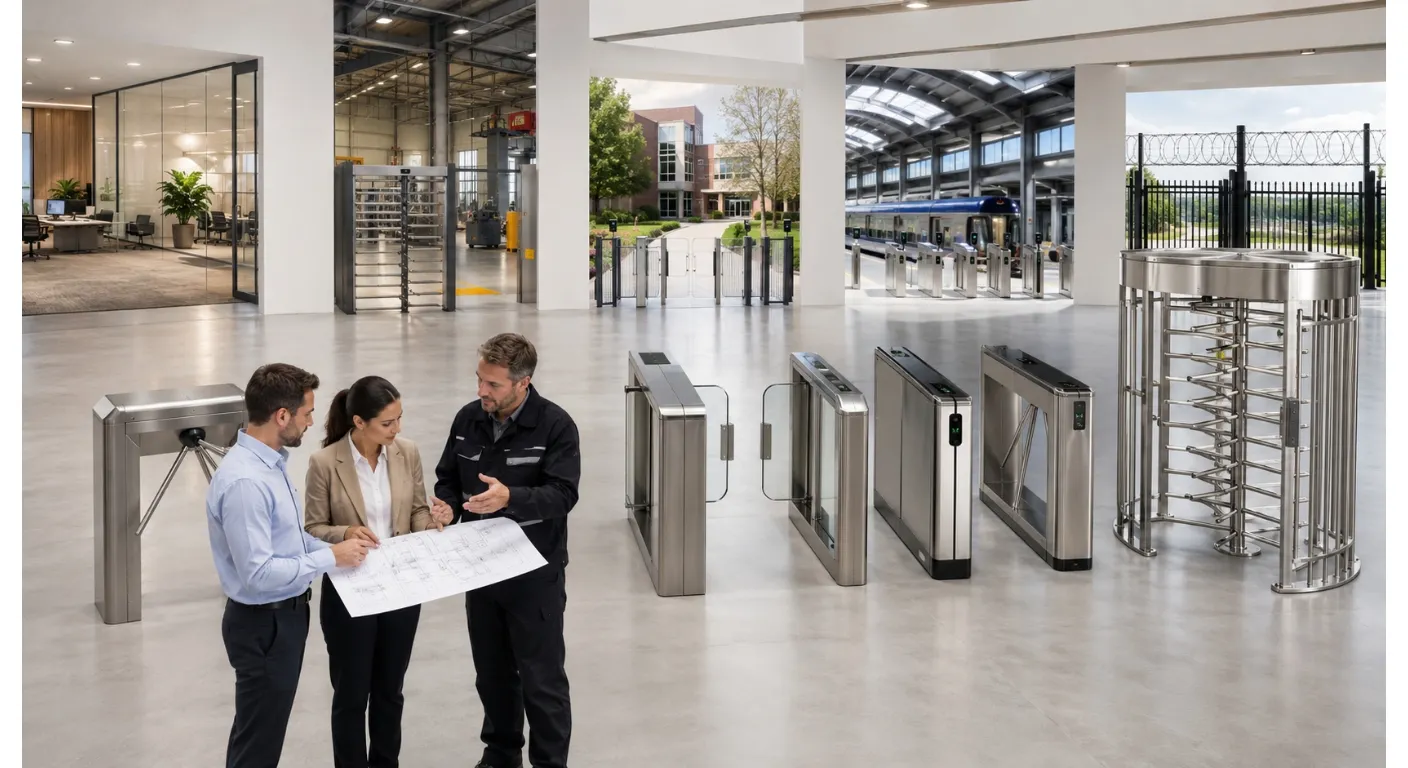
The supplier should use this information to recommend a complete lane arrangement. Buyers can review the available turnstile gate categories and compare them against the actual entrance plan.
Match the Turnstile Type to the Security Objective
Different gates solve different access-control problems. Selecting only by appearance or price may create security gaps, congestion, ou un coût inutile.
| Type de tourniquets | Typical Application | Main Strength | Point to Review |
|---|---|---|---|
| Tourniquet trépied | Usines, Gymnases, et écoles | Compact et économique | Narrow passage and arm movement |
| Porte de barrière pivotante | Bureaux, Hôpitaux, et campus | Large, user-friendly passage | Sensor and anti-collision logic |
| Grille barrière à rabat | Stations and commercial buildings | Fast automated passage | Supervision and lane width |
| Porte de vitesse | Premium, high-traffic entrances | Modern design and intelligent sensing | Higher system complexity |
| Tourniquet pleine hauteur | Perimeters and restricted zones | Contrôle physique fort | Espace, Sortie, and public suitability |
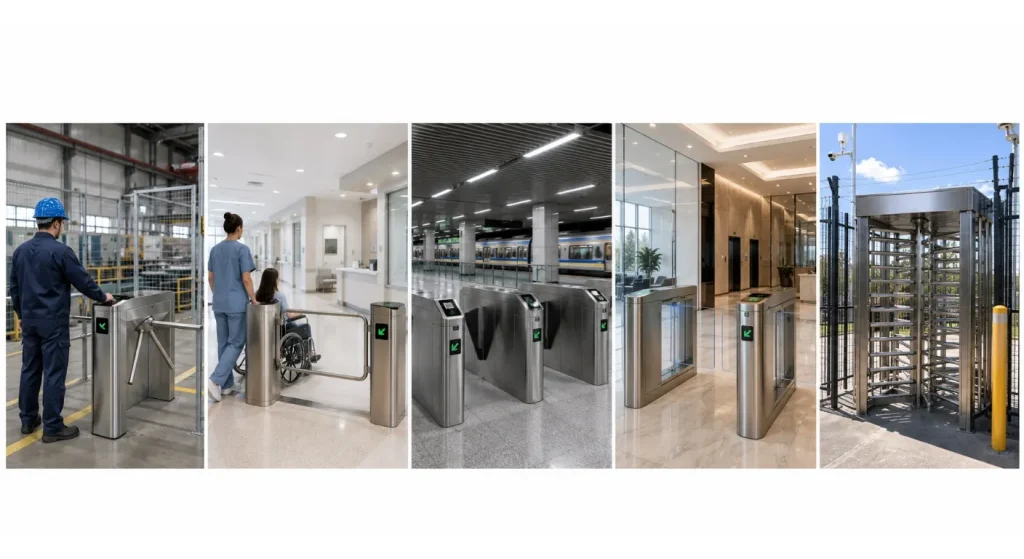
Un Tourniquet trépied may suit employee access, tandis qu’un Porte barrière pivotante supports wider passage. Projects requiring stronger perimeter control can evaluate a Tourniquet pleine hauteur.
The best supplier should be willing to recommend different products for different zones instead of forcing one model into every entrance.
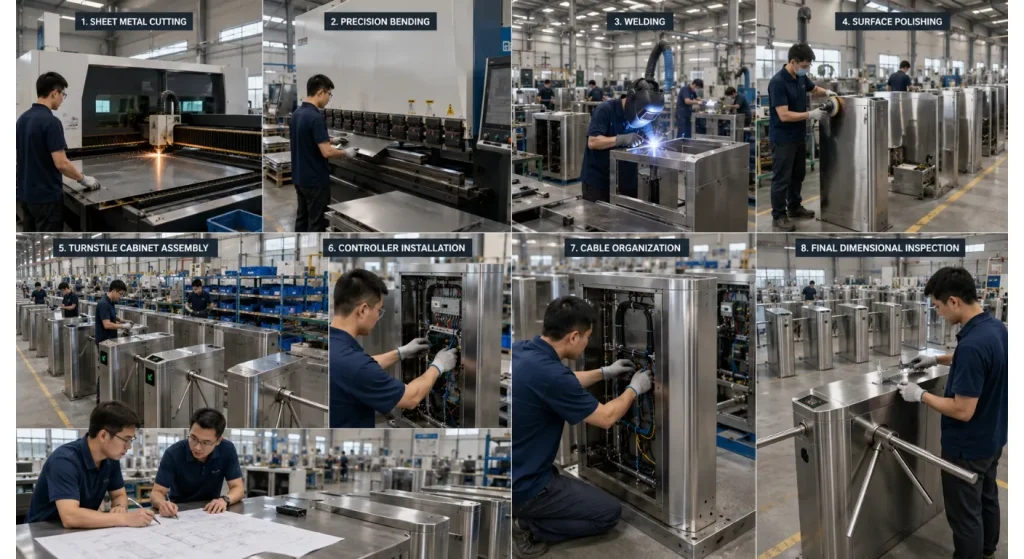
Verify Whether the Supplier Is a Manufacturer or a Catalog Reseller
A broad catalog does not prove manufacturing capability. Buyers should understand which activities are performed by the supplier and which are outsourced.
Ask for evidence of:
- Mechanical design and drawing capability
- Fabrication, finishing, Assemblage, and controller configuration
- Functional and endurance testing
- Incoming-material and final inspection
- Serial-number or batch traceability
- Packaging and export preparation
- Spare-parts inventory
- Engineering support for custom projects
For OEM or distributor programs, clarify which elements can be customized without changing the proven platform. Ironman’s turnstile gate OEM guide distinguishes branding changes from deeper structural or electronic modifications.
A reliable supplier should state which changes require new drawings, Échantillons, revised testing, or a longer schedule.
Treat Access-Control Integration as an Engineering Task
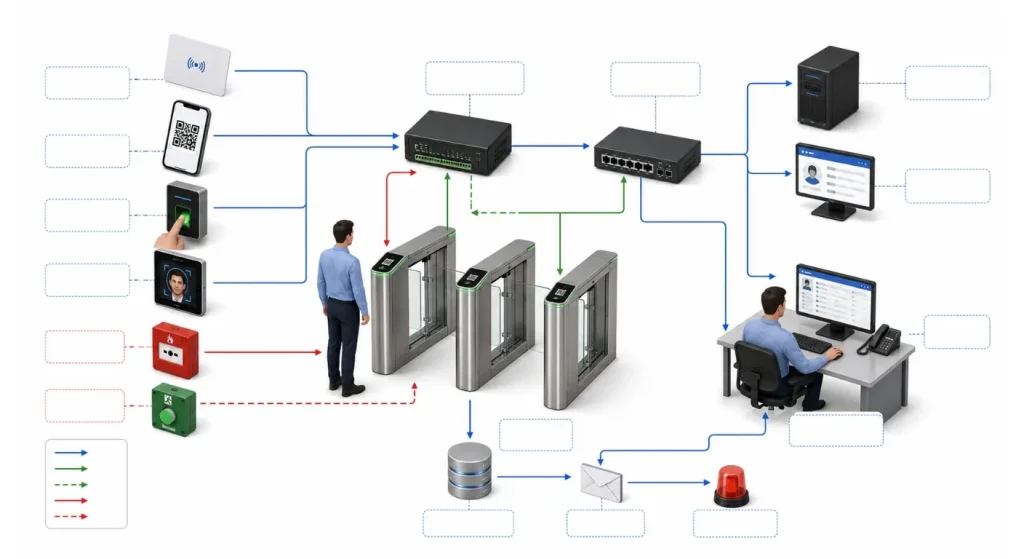
The gate is only one part of the entrance system. Readers, Terminaux biométriques, Contrôleurs, logiciel, network devices, fire-alarm inputs, and operator controls must work together.
Before production, define the reader size and mounting position, Type de certification, opening signal, communication interface, entry and exit logic, alarm inputs, offline operation, event records, and software responsibilities.
Pertinent Équipements de contrôle d’accès can support the project, but compatibility should be demonstrated with interface documents and actual tests.
Pour les États-Unis. Projets, UL explains that RUCHE 294 provides a testing and certification framework for access-control system units. Confirm which specific component or system has been evaluated rather than assuming one certified device makes the complete entrance compliant.
Plan Accessibility and Egress at the Layout Stage
Accessibility cannot be solved by changing a cabinet after production. The layout should include an appropriate route for wheelchair users, Visiteurs avec bagages, delivery carts, and other users who cannot comfortably pass through a narrow turnstile.
Le États-Unis. Access Board guidance states that turnstiles are not part of an accessible route, so an adjacent accessible gate or door may be required for applicable U.S. Projets.
Also confirm what happens during power loss, fire-alarm activation, network failure, Sortie manuelle, and evacuation. The supplier should explain gate behavior, while the designer, intégrateur, operator, and local authority review the complete installation.
Compare Total Project Cost Instead of Unit Price
The lowest unit price may not produce the lowest installed cost. A realistic comparison should include the gate configuration, readers and controllers, Supports de montage, freight, civil work, câblage, Intégration logicielle, Commande, Pièces détachées, et maintenance.
Ironman’s turnstile gate price guide explains that cost varies with gate type, matériel, moteur, barrier design, intégration, and supply channel.
Ask every supplier to quote the same scope. A cheaper gate with missing controllers, unsuitable readers, weak packaging, or limited support can become more expensive after site changes and delays.
Require Clear Drawings and Project Documents
Written documents reduce misunderstandings between the buyer, Fournisseur, installer, and software provider. Before production approval, request:
- Product data sheet and dimensioned drawing
- Lane layout and foundation details
- Power and communication diagram
- Reader-mounting drawing
- Input, output, and emergency-release description
- Installation and maintenance manuals
- Spare-parts list
- Inspection and test plan
- Packing list
Any custom logo, Taille du cabinet, Largeur de passage, reader opening, or finish should appear on an approved drawing. Verbal confirmation is not enough when several parties are involved.
Validate the Complete Configuration Before Shipment
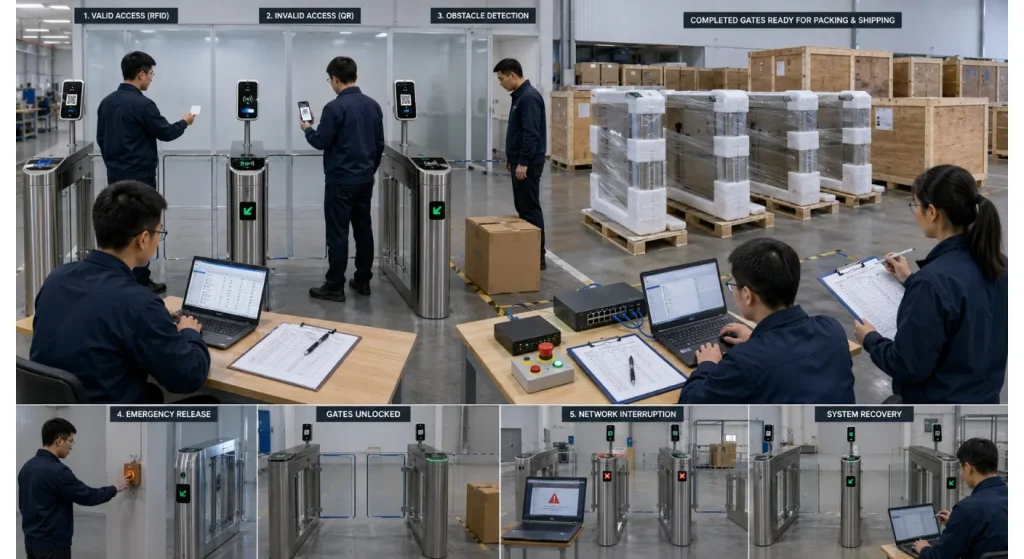
A factory acceptance test should confirm more than appearance. It should reproduce important scenarios using the approved gate, contrôleur, lecteur, and operating logic.
Test correct and invalid credentials, repeated use, Mouvement dans la mauvaise direction, closely spaced users, Détection d’obstacles, passage timeout, power interruption, network loss, emergency input, Sortie manuelle, indicateurs, et des alarmes.
Ask for photos, Vidéos, test records, serial numbers, and packaging evidence before shipment. Technical support videos can also help installers understand configuration and troubleshooting.
Finding integration problems before shipment is usually less costly than correcting them after equipment reaches the site.
Evaluate Installation and Lifecycle Support
The supplier’s responsibility should not end when the shipment leaves the factory. Determine how technical questions, damaged parts, firmware settings, wiring problems, and warranty claims will be handled.
Examinez le turnstile installation guide during site planning and confirm floor preparation, conduits, câblage, anchoring, lane alignment, and commissioning tasks.
Examine the Politique de garantie and ask which parts are covered, what evidence a claim requires, whether remote diagnosis is available, how replacement parts are dispatched, and how long key components remain available.
A dependable supplier provides enough documentation and parts support for the local integrator to maintain the entrance without unnecessary downtime.
Use a Supplier Scorecard
A structured scorecard prevents price from dominating the decision.
| Evaluation Area | Questions to Ask |
|---|---|
| Product fit | Does the gate match the users, Niveau de sécurité, et environnement? |
| Ingénierie | Are drawings, Interfaces, and customization reviewed? |
| Qualité | Are inspections, tests, and traceability documented? |
| Intégration | Has the approved system configuration been tested? |
| Delivery | Are approval, production, packing, and shipping milestones clear? |
| Soutien | Are installation guidance, Pièces, and warranty available? |
| Commercial value | Does the quotation cover the complete scope? |
The strongest supplier is not necessarily the one with the longest product list. It is the one that converts requirements into a documented, Testé, and maintainable entrance solution.
What to Include in a Turnstile Gates RFQ
Send the supplier the site description, entrance drawing, Nombre de voies, security objective, user groups, traffic estimate, Largeur de passage, credential information, access-control platform, environnement, customization requirements, required tests, Portée d’installation, delivery date, and spare-parts expectations.
Submit these materials through the Ironman contact page for a detailed recommendation. A complete RFQ identifies missing information early and reduces quotation changes later.
Conclusion
Choosing a turnstile gates supplier requires more than comparing products and prices. Buyers should examine product suitability, manufacturing capability, intégration, accessibilité, total installed cost, Documentation, factory testing, installation support, and spare-parts availability.
A qualified project partner asks detailed questions, defines technical boundaries, documents custom changes, and tests the approved configuration before shipment. This reduces site modifications, integration disputes, unexpected costs, and maintenance risk.
FAQ
How Can I Verify Whether a Turnstile Supplier Is a Real Manufacturer?
Request factory videos, production photos, engineering drawings, inspection records, and testing evidence. Also confirm which fabrication, Assemblage, contrôleur, and quality-control processes are completed internally.
Which Type of Turnstile Gate Should I Choose?
The correct type depends on the security level, user group, Largeur de passage, traffic flow, et environnement d’installation. Different zones within the same project may require different gate types.
Can Turnstile Gates Integrate With an Existing Access-Control System?
Oui, Quand le lecteur, contrôleur, communication interface, and opening logic are compatible. Provide the supplier with interface documents and test the approved configuration before shipment.
What Documents Should a Supplier Provide Before Production?
Request dimensioned drawings, lane layouts, Schémas de câblage, reader-mounting details, input and output definitions, and an inspection plan. All custom dimensions and finishes should be confirmed on approved drawings.
What Should Be Included in a Turnstile Supplier Quotation?
The quotation should clearly include gates, Contrôleurs, Lecteurs, customization, test, emballage, freight scope, Pièces détachées, et support technique. Compare suppliers using the same project scope rather than unit price alone.
