


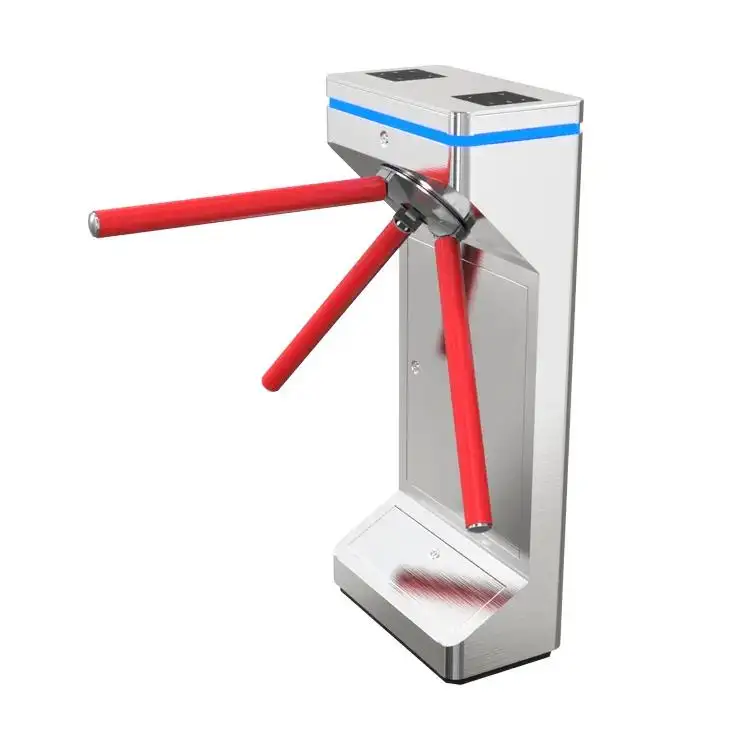
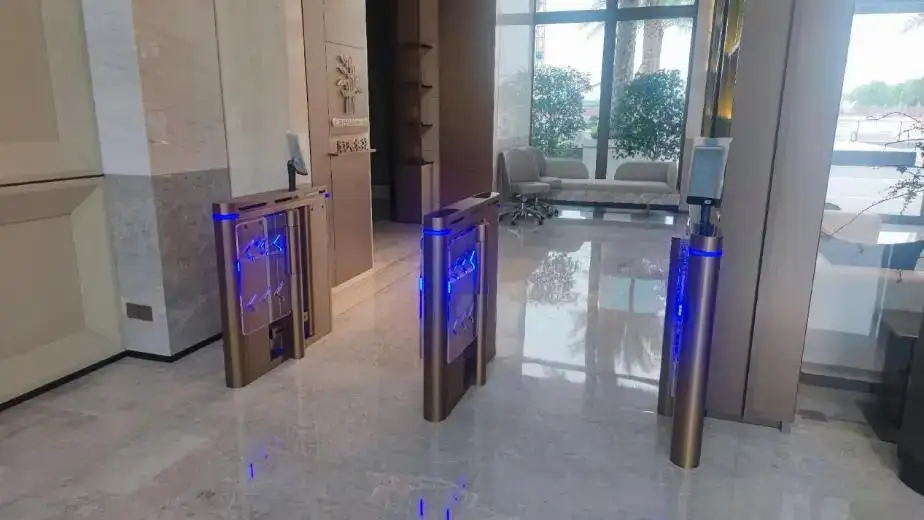
Tourniquet de porte de vitesse: Comment ça fonctionne, Types, et comment choisir le bon
2026-04-12


Un tourniquet de porte de vitesse est une barrière d’accès piétonnier motorisée qui s’ouvre en 0,3 à 0,8 seconde et traite 30 à 60 personnes par minute à l’aide de capteurs optiques et de panneaux d’ailiers rétractables. Cette combinaison de vitesse, Précision, et la conception propre fait des portails de vitesse le système d’entrée privilégié pour les sièges sociaux, Centres de transport en commun, Aéroports, et universités dans le monde entier.
Ce guide explique comment fonctionnent les speed gates, comment ils se comparent aux tourniquets trêpes et aux barrières de rabats, et comment sélectionner le modèle adapté au débit de votre établissement, sécurité, et exigences esthétiques.
ParcourezLa gamme de tourniquets à porte pleine vitesse de l’Ironman pour faire correspondre les spécifications ci-dessous à un produit avant de demander un devis de projet.
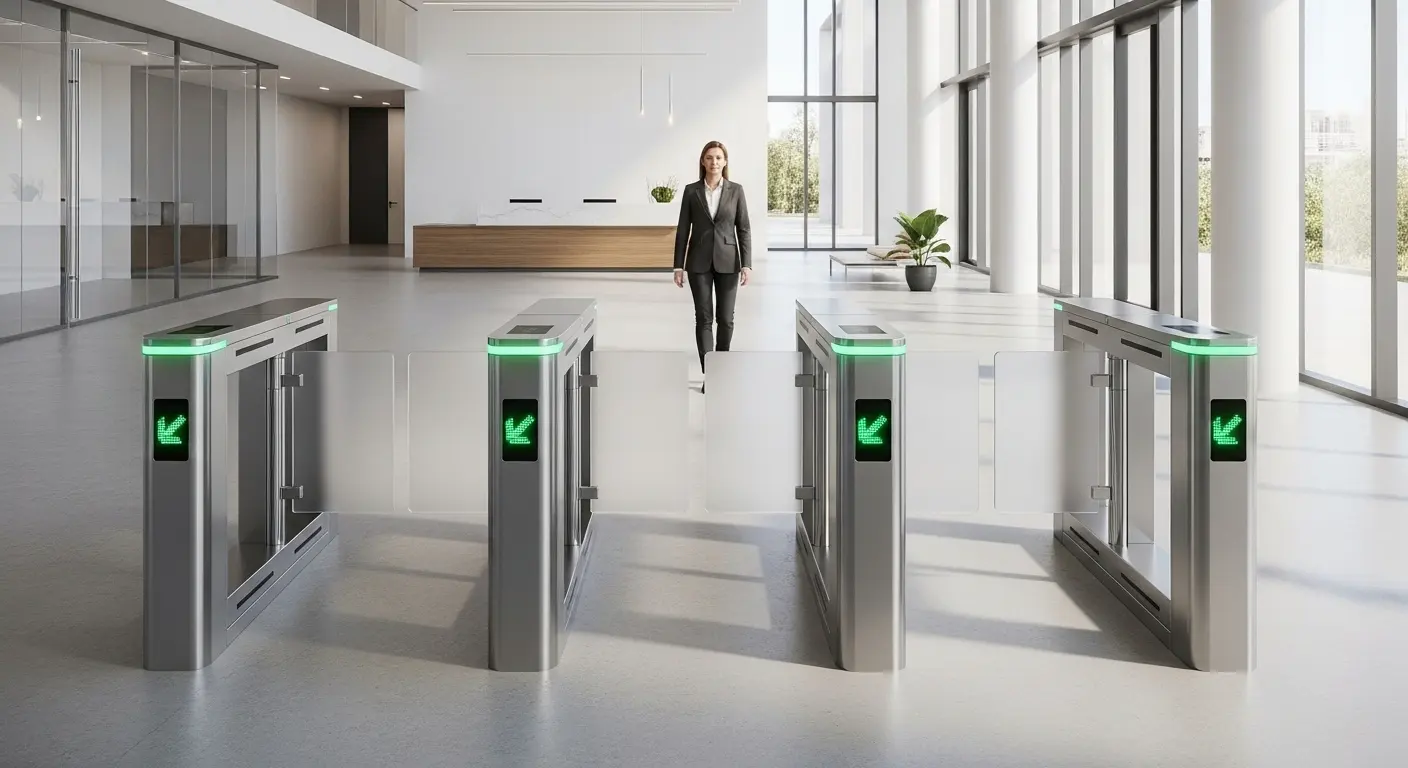
Qu’est-ce qu’un tourniquet de porte de vitesse?
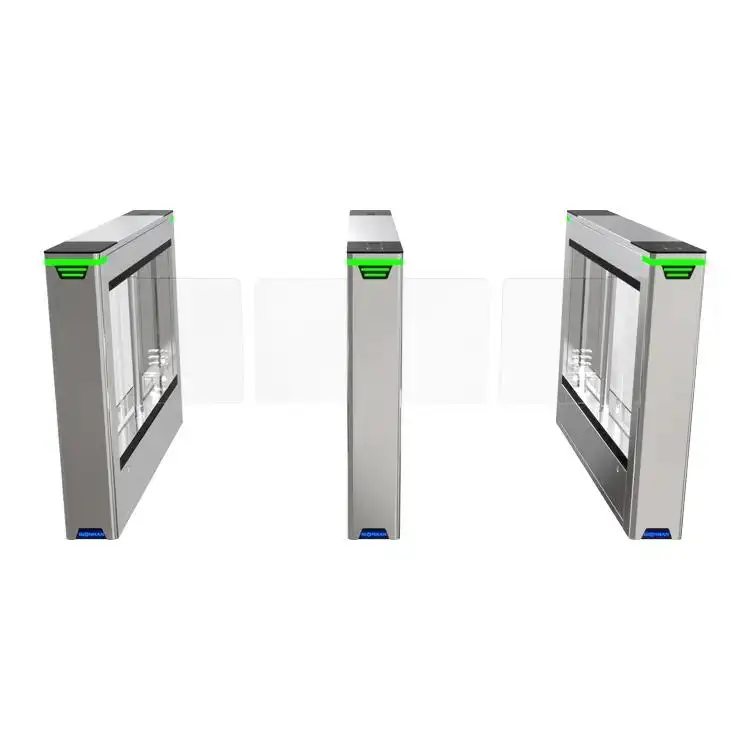
Un tourniquet de speed gate est un peu étroit, barrière de contrôle d’accès à profil bas où des panneaux d’aile rétractables — fabriqués en verre trempé, acrylique, ou acier inoxydable — ouvrir et fermer sur commande d’un moteur DC sans balais intégré et d’un système de capteurs optiques. Contrairement aux tourniquets à trépied à bras rotatif, Les barrières d’une porte de vitesse se rétractent horizontalement ou verticalement dans le corps de l’armoire, laissant le passage dégagé en moins d’une seconde.
Les portails de vitesse sont également appelés tourniquets optiques, Barrières en verre, ou des voies de vitesse selon le fabricant et la région. Tous concernent la même catégorie de produits.
Trois caractéristiques définissent ce type de porte:
- Vitesse d’ouverture: 0.3–0,8 seconde par cycle — réglable pour l’environnement de déploiement
- Débit: 30–60 personnes par minute par voie, selon le modèle et le schéma de trafic
- Profil du cabinet: Mince (150–300 mm de large), typiquement entre 980 et 1 050 mm de haut — elle s’intègre naturellement dans les conceptions modernes de halls et de couloirs
Comment fonctionne un tourniquet de porte de vitesse
Un tourniquet de porte de vitesse fonctionne par une boucle de rétroaction en temps réel entre le lecteur de crédentiel, Le contrôleur embarqué, Le moteur, et l’ensemble de capteurs. Le cycle complet de la remise des accréditations à la fermeture des portes se termine en dessous 1.5 Secondes pour la plupart des installations.
La séquence d’entrée
Voici le processus étape par étape pour chaque candidature autorisée:
- Titre présenté: L’utilisateur tape une carte RFID, scanne un code QR, présente une empreinte digitale, ou se tient devant un terminal de reconnaissance faciale.
- Signal au contrôleur: Le lecteur envoie l’identifiant au panneau de contrôle d’accès embarqué via Wiegand ou RS485 — la vérification prend en charge 0.2 Secondes.
- Panneaux d’ailes ouverts: Le moteur à courant continu sans balais s’active et les panneaux d’ailes se rétractent dans la carrosserie du meuble. Les flèches de direction LED passent au vert.
- Passage confirmé: Le réseau de capteurs détecte l’utilisateur se déplaçant dans la voie et confirme que le passage est terminé.
- Fermeture de la porte: Les panneaux d’ailes se remettent en place. La LED se réinitialise. L’événement — horodatage, identifiant de crédent, direction, Voie — journaux vers le système.
- Refus d’entrée: Si la certification échoue, Les panneaux restent fermés, Un indicateur rouge s’active, et une alarme optionnelle retentit.
Technologie des capteurs optiques
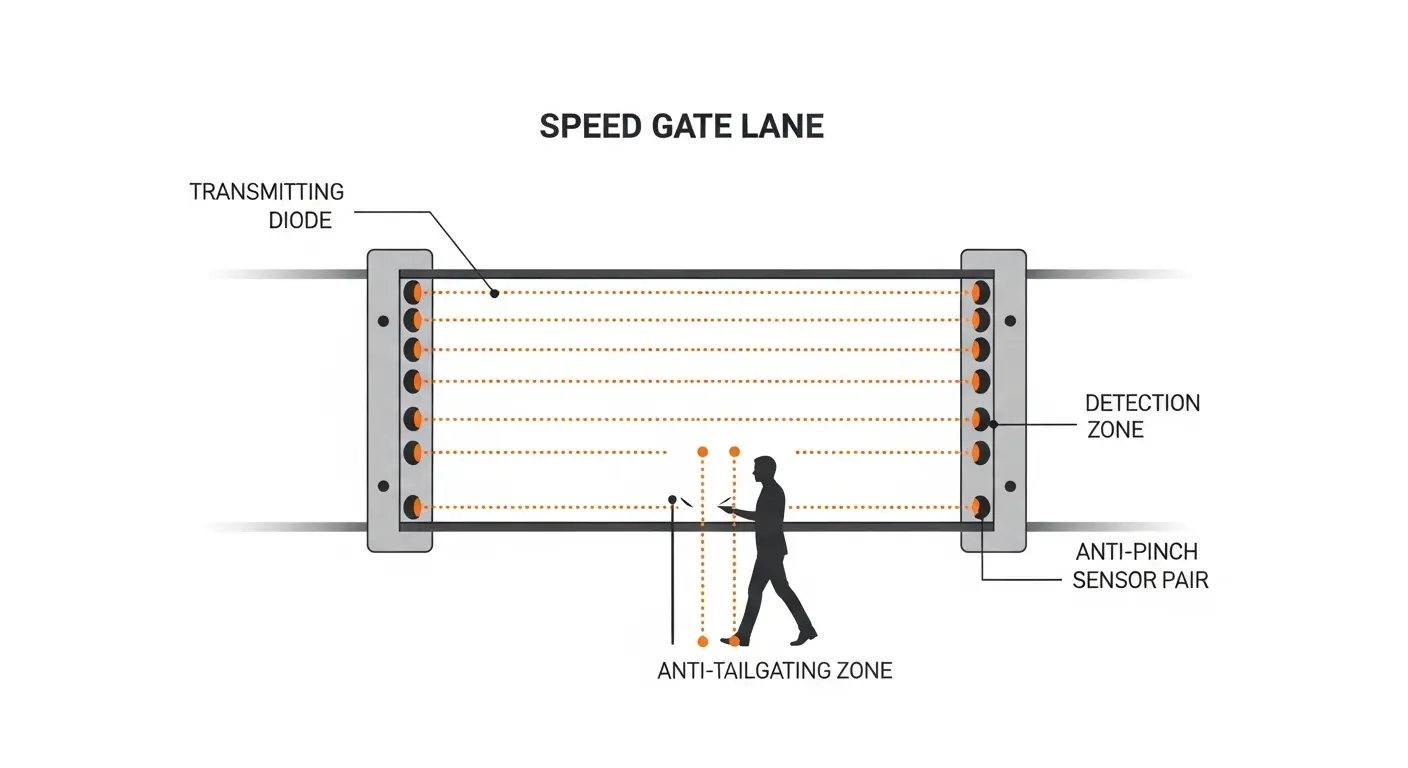
Le réseau de capteurs est ce qui distingue un tourniquet de porte de vitesse des anciens systèmes mécaniques. Plusieurs paires de capteurs infrarouges — généralement 4 à 16 paires selon le modèle — créent une grille de détection sur toute la longueur de la voie.
Cette grille détecte quatre états distincts: un utilisateur autorisé entrant, Une tentative d’entrée non autorisée, une seconde personne suivait de près (talonnage), et un obstacle physique en plein passage. Lorsque le système détecte le tailgate, Cela déclenche une alarme et referme immédiatement les panneaux. Quand il détecte une obstruction lors du cycle de fermeture, Les panneaux s’arrêtent et reculent automatiquement — la fonction anti-pincement qui prévient les blessures.
Des flèches de direction LED d’état sur le dessus du meuble ou les panneaux d’aileron guident les utilisateurs en temps réel. Vert signifie passer. Rouge signifie refusé. Cela supprime les incertitudes que les anciennes grilles mécaniques exigeaient.
Tourniquet de porte de vitesse vs. Autres systèmes d’entrée
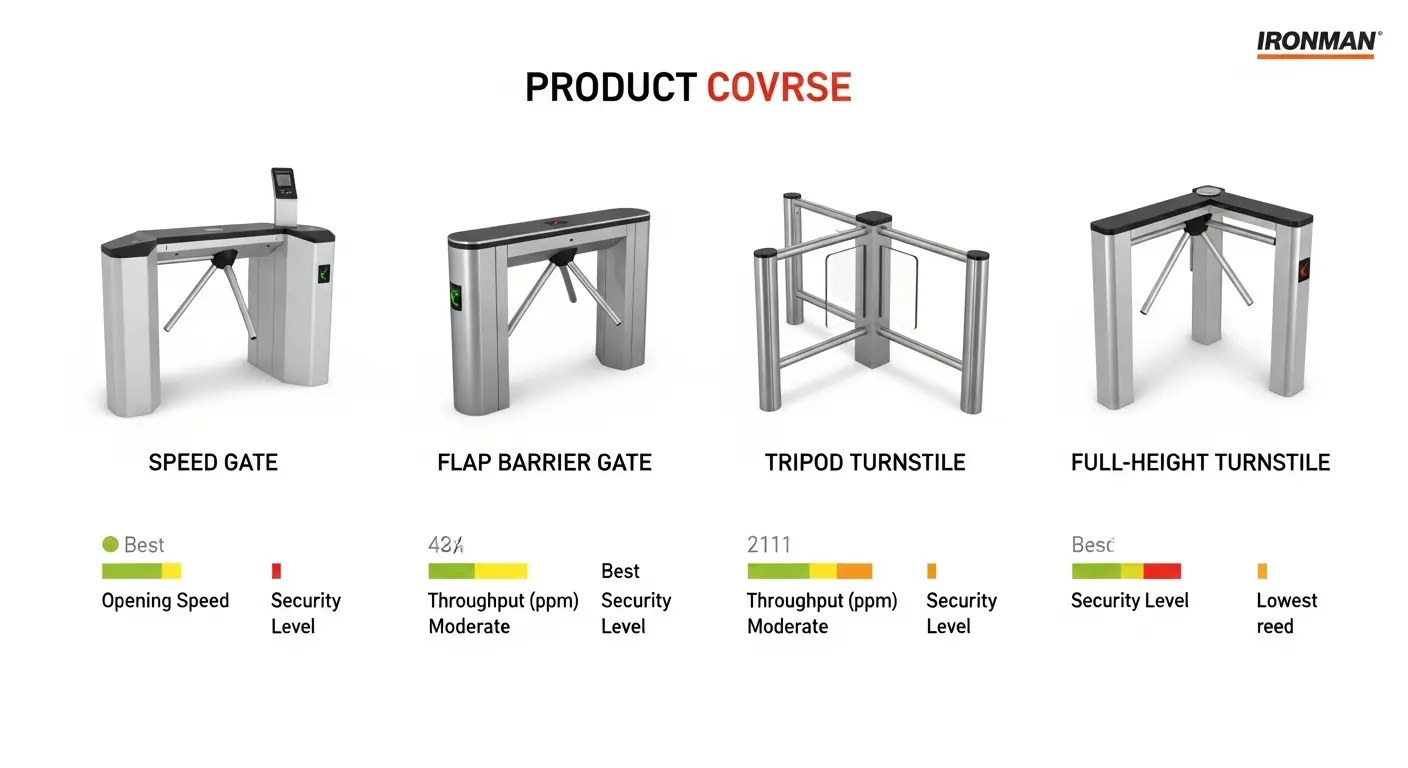
Les tourniquets de portails de vitesse se situent en tête du spectre du débit et de l’esthétique parmi les systèmes de contrôle d’accès piéton. Choisir le bon type de système nécessite d’adapter le volume de trafic de votre établissement, Niveau de sécurité, et les exigences de conception par rapport aux données réelles de performance de chaque option.
| Porte de vitesse | Barrière de volets | Tourniquet trépied | Tourniquet pleine hauteur | |
|---|---|---|---|---|
| Vitesse d’ouverture | 0.3–0,8 s | 0.5–1,5 s | 1–2 secondes | 2–4 secondes |
| Débit | 30–60 ppm | 25–50 ppm | 20–40 ppm | 10–20 ppm |
| Niveau de sécurité | Moyen-Haut | Douleur moyenne | Bas-moyen | Très haut |
| Voie large ADA | Oui (850–1 000 mm) | Limité | Non | Non |
| Esthétique | Premium | Premium | Standard | Industriel |
| Homologué pour l’extérieur | Modèle IP65 disponible | Limité | Oui | Oui |
| Le meilleur pour | Entreprise, transit, université | Bureaux, Publicité légère | Entrepôts, Gymnases | Sécurité périphérique |
Les portes de vitesse mènent en débit et en vitesse d’ouverture. Pour tout point d’entrée où le débit piéton est la spécification principale, C’est la bonne catégorie de produit.
Les tourniquets trépied supportent des débits réguliers jusqu’à 40 ppm mais ne conviennent pas aux salons à forte affluence où la file d’attente est inacceptable. Les tourniquets pleine hauteur offrent la plus grande sécurité physique contre les barrières mais ne conviennent pas aux environnements d’entreprise ou d’hôtellerie publics où la qualité esthétique est importante.
Caractéristiques clés d’un tourniquet à porte de vitesse
Les vannes modernes incluent un ensemble standard de dispositifs de performance et de sécurité. Comprendre ces éléments aide les acheteurs à comparer les modèles et à confirmer qu’un produit proposé répond aux spécifications du projet.
Résistance et performance moteur
Les données mécaniques de performance de base pour une porte de vitesse de qualité:
- Vitesse d’ouverture et de fermeture: Réglable 0,3–1,0 seconde — réglé plus rapidement pour les heures de pointe à fort trafic, plus lent pour les environnements à faible contrôle de trafic
- Type moteur: Moteur DC sans balais avec encodeur de position pour un contrôle précis du panneau et un fonctionnement quasi silencieux
- MTBF: ≥5 millions de cycles pour des portails de vitesse de qualité — à 300 cycles par jour, qui est égal à sur 45 Des années de fonctionnement avant que le moteur ne nécessite de l’attention
- Matériaux des panneaux d’aile: Verre trempé (Esthétique premium), acrylique (Norme et économique), Tige en acier inoxydable (environnements à fort impact)
- Options de largeur de voie: 550–600 mm standard pour le flux RFID mono-utilisateur; large 850–1 000 mm pour l’accès aux fauteuils roulants et bagages ADA
Fonctions de sécurité et de sûreté
La sécurité et le comportement d’urgence sont des éléments non négociables dans la spécification. Assurez-vous que tous les éléments suivants sont présents avant d’acheter:
- Anti-pêche au collage: La détection du corps secondaire déclenche l’alarme et la refermeture automatique des portes — un critère crucial pour les environnements d’accès contrôlés
- Anticollision / Anti-pincement: Les panneaux s’arrêtent et reculent immédiatement lorsqu’un obstacle est détecté lors du cycle de fermeture
- Mode d’urgence de sécurité: Les panneaux d’ailes se rétractent complètement et restent ouverts lors d’une alarme incendie ou d’une coupure de courant — nécessaire pour la conformité à la sortie selon la NFPA 101 et les codes locaux de sécurité incendie
- Mode sécurisé en cas de défaillance: Les panneaux restent fermés pendant la coupure de courant — configurés uniquement pour les voies à haute sécurité sans sortie
- Options complémentaires: Flèches LED de direction, Alarme, Affichage d’état LCD, sortie relais d’intégration pour VMS ou BMS
Intégration du contrôle d’accès
Un tourniquet de porte de vitesse se connecte à pratiquement tout système de certification actuellement en service:
- Types de crédentials: Carte RFID (Wiegand 26/34 bits), Empreinte biométrique, iris, Terminal de reconnaissance faciale, Code QR, NFC, code-barres
- Communication: TCP/IP pour les systèmes connectés au cloud, RS485 pour les systèmes multi-portes basés sur des panneaux, Relais à contact sec pour un signal simple d’ouverture/fermeture
- Logiciel: Plateformes de présence RH, Systèmes de gestion des visiteurs, Logiciel de billetterie, Systèmes de gestion des bâtiments
- Certifications à exiger: CE, RoHS, ISO 9001 Gestion de la qualité; IP54 pour l’intérieur; IP65 pour les lieux extérieurs ou semi-extérieurs — vérifié sous IEC 60529 standard
Types de tourniquets à portails de vitesse
La gamme Speed Gate d’Ironman couvre quatre niveaux de produits distincts. Chaque niveau est optimisé pour un volume de débit différent, Exigence de fonctionnalité, et niveau budgétaire.
Porte de vitesse optique
La porte de vitesse optique utilise une grille de capteurs infrarouges comme méthode principale de détection avec des panneaux d’ailes en verre trempé ou acrylique. Il offre l’esthétique de hall haut de gamme que la plupart des acheteurs d’entreprise préfèrent. Pour les environnements où la qualité de conception et la fiabilité opérationnelle sont deux critères principaux, C’est la recommandation standard.
Le meilleur pour: Siège, Institutions financières, Immeubles de bureaux de luxe.
Explorez leTourniquet de porte optique Ironman pour les spécifications complètes du produit.
Porte de vitesse intelligente
La smart speed gate ajoute une couche intelligente: Compatibilité des terminaux de reconnaissance faciale, Connectivité cloud, Analytique d’accès en temps réel, et gestion à distance. Lorsque nous avons installé des portails de vitesse intelligents dans un bâtiment commercial singapourien, l’équipe informatique du client a finalisé l’intégration de la reconnaissance faciale au sein de 48 heures utilisant le pack SDK d’Ironman.
Le meilleur pour: Campus technologiques, Déploiements corporatifs multi-sites, Installations gouvernementales nécessitant une authentification à double facteur.
Voir leTourniquet Ironman Smart Speed Gate pour les spécifications d’intégration.
Porte de vitesse à haut débit
La porte de vitesse à haut débit est conçue pour le volume. Panneaux à deux parties, Une zone de détection plus large, et une réponse motrice plus rapide permet de livrer 50 à 60 personnes par minute par voie. Dans notre déploiement dans le lobby des entreprises aux Pays-Bas, une configuration à 4 voies à haut débit traitée 1,200+ Entrées quotidiennes sans aucune plainte lors de la première 90 Jours d’exploitation.
Le meilleur pour: Gares de transport en commun, Stades, Centres d’exposition, Entrées principales de l’université.
Consultez la fiche technique complète sur lePortail de vitesse à haut débit Ironman Page.
Porte de vitesse commerciale
La porte de vitesse commerciale est l’option de gamme économique pour les projets de taille moyenne. Il comprend un moteur brushless, Panneaux de verre standards, et un contrôleur prêt RFID à un prix inférieur à celui des modèles optiques ou intelligents.
Le meilleur pour: Bureaux de taille moyenne, Gymnases, Espaces de coworking, Centres commerciaux.
Voir lePortail commercial Ironman Pour les dimensions et le contexte tarifaire.
Où les tourniquets de la porte de vitesse sont utilisés
Les tourniquets de porte de vitesse sont déployés dans tout environnement où le flux piétonnier est élevé, Qualité esthétique, et une vérification fiable des accréditations doit coexister. Voici les cinq scénarios de déploiement les plus courants basés sur les données du projet Ironman:
- Sièges et halls de bureaux: Entrées à plusieurs voies donnant sur les zones d’accueil. L’alignement de conception avec l’intérieur du bâtiment est aussi important que le débit. Ironman’sDéploiement dans le hall d’entrée des bâtiments aux Pays-Bas montre une installation réelle à 4 voies dans un environnement d’entreprise haut de gamme.
- Centres de transit et terminaux de transport: Le volume est le principal moteur — les modèles à haut débit gérant 50–60 ppm par voie remplacent les anciens trépieds lors de mises à niveau à l’échelle de la station.
- Universités et campus: Fort trafic matinal aux heures de pointe, Configurations à entrées multiples, Exigences ADA pour les voies larges. L’accès par carte ou reconnaissance faciale est standard.
- Aéroports et terminaux internationaux: Modèles certifiés IP65 pour les zones partiellement exposées. Intégration avec les systèmes de gestion des billets et de récupération des bagages requise.
- Soins de santé et installations gouvernementales: Portails de vitesse intelligents avec authentification à double facteur — RFID plus reconnaissance faciale. LeDéploiement du contrôle d’accès Ironman UK démontre cette configuration dans un environnement réglementé.
Comment choisir le bon tourniquet de porte de vitesse
Adapter votre installation au bon modèle de speed gate se résume à deux décisions principales: Exigences de débit et niveau de fonctionnalité. Utilisez cette matrice pour restreindre vos choix avant de contacter un fournisseur.
Par exigence de débit
- Sous 500 Entrées quotidiennes par voie: Porte de vitesse commerciale ou optique — une spécification standard de moteur de 30 à 40 ppm est suffisante
- 500–1 500 entrées quotidiennes par voie: Porte optique ou intelligente — moteur brushless avec encodeur à 40–50 ppm
- 1,500+ Entrées quotidiennes par voie: Portail de vitesse à haut débit — panneaux à deux parties, 50–60 ppm, Temps de recyclage le plus rapide
Par exigence de fonctionnalité
| Exigence | Modèle recommandé |
|---|---|
| Gestion cloud à distance + analytique | Porte de vitesse intelligente |
| Esthétique en verre haut de gamme, Performance fiable | Grille de vitesse optique |
| Aménagement commercial soucieux de son budget | Porte de vitesse commerciale |
| Volume maximal, Transport en commun ou utilisation dans les stades | Porte de vitesse à haut débit |
| Installation en extérieur ou semi-extérieur | Tout modèle avec une certification IP65 confirmé |
| Voie pour fauteuils roulants ADA requise | Modèle à large voie — largeur libre de 850 à 1 000 mm |
Dans notre expérience à travers 3,000+ Projets GATE à l’échelle mondiale, Les établissements qui investissent dès le départ dans le bon niveau de débit rapportent moins d’appels de maintenance et aucune plainte lors de la file d’attente durant la première année d’activité. Choisir un modèle un niveau en dessous de votre volume de trafic de pointe réel est l’erreur de spécification la plus courante que nous voyons — et elle est totalement évitable au stade du devis.
Questions fréquemment posées
Q1: Qu’est-ce qu’un tourniquet de porte de vitesse et en quoi diffère-t-il d’un tourniquet classique?
Un tourniquet de porte de vitesse est une barrière de contrôle d’accès à profil bas avec panneaux ailarés en verre rétractable ou en acrylique, un réseau de capteurs optiques, et un moteur à courant continu sans balais. Il se distingue d’un tourniquet trépied classique à trois égards: Il s’ouvre en 0,3–0,8 seconde vs. 1–2 secondes pour un trépied; Il traite 30 à 60 personnes par minute vs. 20–40 pour un trépied; et il utilise la détection par capteur plutôt qu’un bras rotatif physique nécessitant une force corporelle pour fonctionner. Les portails de vitesse ont aussi un aspect nettement plus raffiné, Ce qui les rend adaptés aux salons haut de gamme où les tourniquets de trépied dépareraient.
Q2: À quelle vitesse un tourniquet de porte de vitesse s’ouvre-t-il et se ferme-t-il?
Un tourniquet de porte de vitesse de qualité s’ouvre en 0,3 à 0,8 seconde et se ferme à la même vitesse après le passage de l’utilisateur. La vitesse est réglée via le contrôleur embarqué — plus rapide lors des heures de pointe matinales très fréquentées, Un peu plus lentement pour les environnements où la population d’utilisateurs comprend des personnes âgées ou des personnes déficientes de mobilité. La plupart des installations utilisent un point de départ par défaut de 0,5 seconde.
Q3: Combien de personnes par minute un tourniquet de porte de vitesse peut-il traiter?
Une porte de vitesse standard gère 30 à 50 personnes par minute en mode accès contrôlé — où chaque utilisateur présente une accréditation. En mode écoulement libre (panneaux rétractés, Surveillance uniquement), Étends le débit 60+ Personnes par minute. Les modèles à haut débit avec panneaux à deux parties supportent 50 à 60 ppm en mode contrôlé. Pour la planification des transports en commun ou des stades, Budget 40 à 50 ppm par voie pour tenir compte de la variation réelle des numérisations de créances.
Q4: Que se passe-t-il avec une porte de vitesse lors d’une alarme incendie ou d’une panne de courant?
En mode fail-safe — la configuration standard pour toute voie faisant partie d’une sortie d’urgence — les panneaux d’ailiers se rétractent complètement et restent ouverts lorsque l’alimentation est coupée ou qu’un signal d’alarme incendie est reçu. Cela permet de garder la sortie dégagée pour l’évacuation et de répondre aux exigences de la NFPA 101 (Code de sécurité de la vie) et des réglementations locales équivalentes sur les incendies. En mode fail-secure — utilisé uniquement dans les voies non-sorties à haute sécurité — les panneaux restent fermés pendant la coupure de courant. Vérifiez toujours que la configuration en mode défaillance correspond au plan d’évacuation de votre bâtiment avant l’installation.
Q5: Un tourniquet de porte de vitesse peut-il être utilisé à l’extérieur?
Oui, à condition que le modèle possède une protection contre les intrusions IP65 selon IEC 60529. Les portails de vitesse intérieurs standards sont homologués IP54 et ne conviennent pas à la pluie ou à une exposition prolongée en extérieur. Pour les déploiements en plein air, Spécifiez également un acier inoxydable 316 Cabinet (Qualité marine) si le site est côtier ou dans un environnement à forte humidité. Vérifiez que la plage de température de fonctionnement correspond à votre climat — les modèles de qualité fonctionnent de -20°C à 60°C.
Q6: Avec quels systèmes de contrôle d’accès un tourniquet de porte de vitesse peut-il s’intégrer?
Les tourniquets à portails de vitesse s’intègrent à tous les principaux types de certifications: Lecteurs de cartes RFID (Wiegand 26/34 bits), Terminaux biométriques (empreinte digitale, iris, Reconnaissance faciale), Scanners de codes QR, NFC, et des lecteurs de codes-barres. Les interfaces de communication incluent TCP/IP (Cloud et LAN), RS485 (Panneau multi-grilles), et relais à contact sec (Signal d’ouverture/fermeture simple pour les systèmes hérités). Au niveau logiciel, ils se connectent aux plateformes RH de présence, Systèmes de gestion des visiteurs, Logiciel de billetterie, et systèmes de gestion de bâtiments. Confirmez le protocole spécifique utilisé par votre logiciel existant avant de spécifier un modèle de porte.
Faire votre choix
Trois variables déterminent chaque décision de sélection de la porte de vitesse: Exigence de débit, Niveau des fonctionnalités, et environnement (En salle vs. extérieur, ADA contre. standard). Les tourniquets de la porte de vitesse s’ouvrent en 0,3 à 0,8 seconde, Traiter 30 à 60 personnes par minute, et transportent une MTBF de ≥5 millions de cycles — ce qui en fait le système d’entrée à fort trafic le plus fiable pour l’environnement bâti moderne.
Navires Ironman 100,000+ Speed Gate chaque année pour des projets à travers l’entreprise, transit, gouvernement, et les secteurs de l’éducation dans 50+ pays. Notre équipe d’ingénierie fournit des spécifications spécifiques au projet, Recommandations pour le nombre de voies, et des devis détaillés complets à l’intérieur 12 Heures d’ouverture.
Consultez la gamme complète de tourniquets Speed Gate Ironman Pour trouver le modèle adapté à votre projet — ou contactez-nous directement pour obtenir une spécification et un devis adaptés à votre site.
